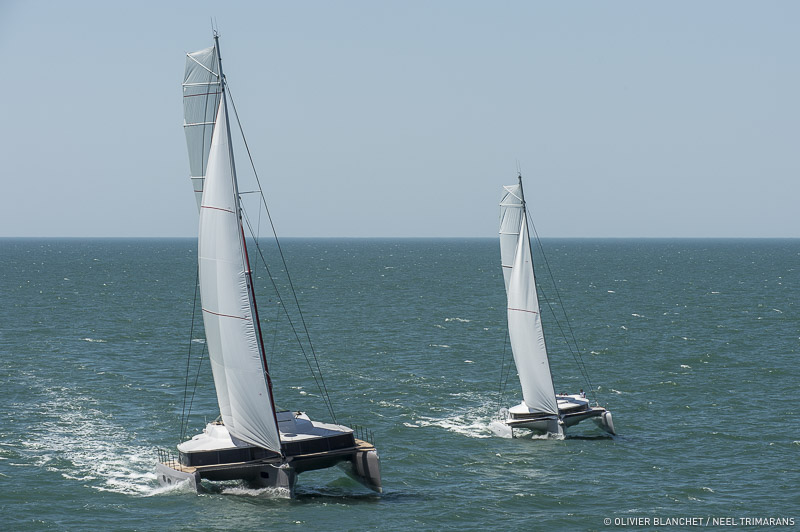
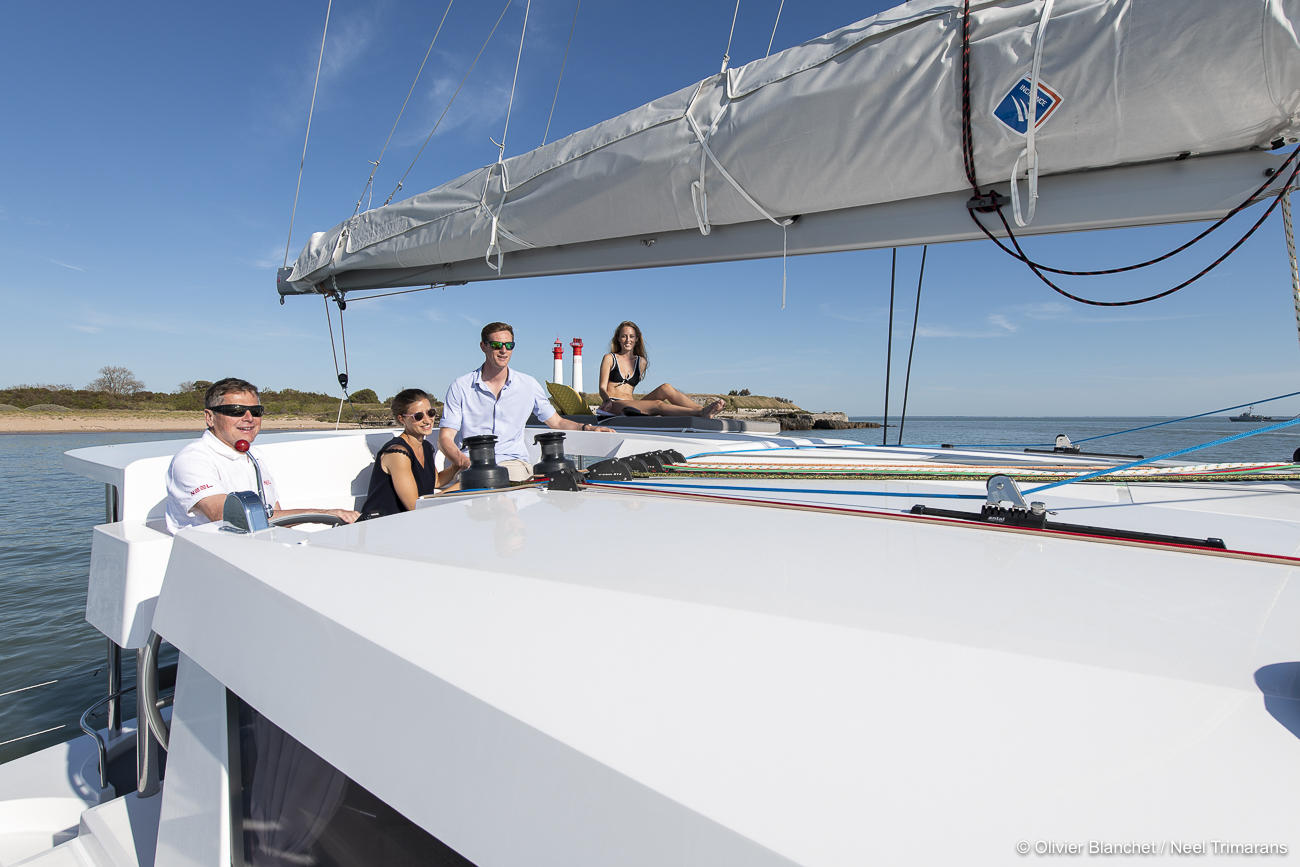
As demonstrated by offshore races and major sailing events, trimarans are significantly faster than catamarans. This advantage is also evident among cruising trimarans, as illustrated by the results of the Atlantic Rally for Cruisers (ARC).
This advantage becomes even more noticeable when sailing upwind.
Thanks to its exceptionally rigid structure, which allows for perfectly optimised rigging, together with its anti-drift foils, the trimaran delivers upwind performance comparable to that of a high-performance monohull.
The trimaran’s higher speed also provides an additional level of safety.
Steering finesse
The finesse of the steering is a feature highly appreciated by owners of NEEL-TRIMARANS, especially those who have previous experience on high-performance monohulls.
A central hull that naturally keeps the boat “as if on rails”:
A single wheel steering system connected to a single rudder by spectra lines.
The most direct line path possible to optimize the sensations at the helm.
The rudder stock on self-aligning bearings
A deep rudder under the central hull contributes to the anti-drift surface and allows an efficient tacking.
NEEL trimarans are conceived for fast cruising
With an average cruising speed of around 10 knots, over 200 nautical miles are easily achievable each 24 hours. Speeds from 15 to 18 knots are often reached when the breeze freshens.
Weight centering is managed in order to limit pitching. The centre hull is rockered to facilitate tacking.
Floats are of a stretched form to privilege directional stability and advancement of the centre of buoyancy as a function of sail loading. The rig is directly inspired by racing trimarans, allowing cruising speeds on every point of sail that are significantly higher than those of conventional cruising yachts.
The sail surface area is generous with some 17m2 per tonne.
Finally, the trimaran configuration also facilitates sustained speed under motor propulsion. The low prismatic coefficient of the central hull means drag is very weak. The side floats are only very lightly in contact with the surface of the water.
This website uses cookies to improve your experience. We'll assume you're ok with this, but you can opt-out if you wish. Cookie settingsACCEPT
Privacy & Cookies Policy
Privacy Overview
This website uses cookies to improve your experience while you navigate through the website. Out of these cookies, the cookies that are categorized as necessary are stored on your browser as they are essential for the working of basic functionalities of the website. We also use third-party cookies that help us analyze and understand how you use this website. These cookies will be stored in your browser only with your consent. You also have the option to opt-out of these cookies. But opting out of some of these cookies may have an effect on your browsing experience.
Necessary cookies are absolutely essential for the website to function properly. This category only includes cookies that ensures basic functionalities and security features of the website. These cookies do not store any personal information.
Any cookies that may not be particularly necessary for the website to function and is used specifically to collect user personal data via analytics, ads, other embedded contents are termed as non-necessary cookies. It is mandatory to procure user consent prior to running these cookies on your website.